From Scrapbook to Shared Archive: How Sporting Memory Travels
See how sporting memory travels from a family scrapbook into a shared archive, preserving personal stories while giving younger fans room to add their own.
A creased match ticket can carry a family’s sporting memory further than a polished trophy photograph. Sporting memory travels when someone explains why the ticket was kept, another person adds what they remember, and the object becomes part of a story that can be revisited and changed.
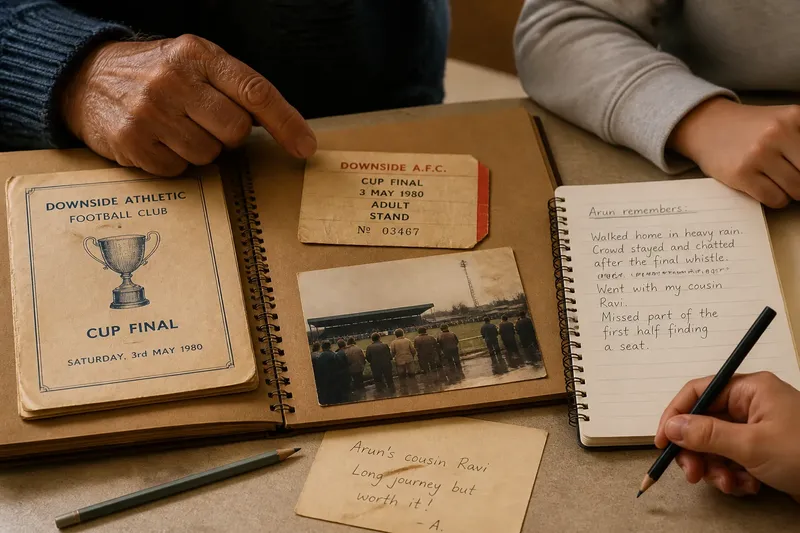
Imagine that Leila, a fictional teenager, finds an old scrapbook while clearing a cupboard with her grandfather, Arun. It holds a faded programme, a ticket stub and a photograph from a local club’s cup run. Arun remembers the wet walk home after the match; Leila knows the club through recent games and the stories her family repeats. Their small project begins with a question: how can a private keepsake become a shared archive without pretending that everyone remembers it in the same way?
What can a keepsake tell you beyond the result?
The scrapbook offers clues, not a complete account. The programme shows who was listed to play and how the club presented the occasion. The ticket suggests that someone kept a physical trace of being there. The photograph records a view of the day, but not what happened outside its frame.
Arun supplies one layer of meaning. He recalls that the crowd stayed near the ground after the final whistle, talking over the match and waiting for the rain to ease. Leila notices the hand-written note on the programme’s back cover: a relative’s name, followed by a short remark about the journey. Neither detail appears in a scoreline. Together, they connect the event to the ordinary work of attending, remembering and telling.
That distinction matters. An object can prompt a memory, but it cannot verify every part of the story by itself. A photograph may be posed; a caption may have been added years later; a ticket may have belonged to someone who did not attend. The archive grows more trustworthy when it keeps the object and the account beside each other, rather than asking one to stand in for the other.
Start by asking who kept an item and what they say it means.
How does a family story change as it is retold?
Arun’s version has a clear shape: the club reached the cup final, the weather turned miserable, and the supporters made the long journey home together. Leila asks where he sat and who was with him. His answers bring forward details that had been flattened by repetition: he went with an older cousin, missed part of the first half while finding a seat, and remembers the walk home more sharply than the match itself.
These details do not expose the story as false. They show how memory selects. When a family retells an event, it often preserves what matters to the teller, not a complete minute-by-minute record. A younger listener can ask for the setting, the people and the small decisions around the match. Those questions make the story more vivid without forcing it into a definitive version.
Leila adds her own response: the old programme looks formal beside the club’s current matchday notices, and she wonders whether the ground felt as familiar to Arun then as it does to her now. Her contribution does not replace his recollection. It marks the point where the memory reaches a new generation, carrying both continuity and difference.
A useful archive records who is speaking and when the account was shared. “Arun remembers…” leaves room for another relative to say, “I was there too, but I recall it differently.” That small attribution protects disagreement from being mistaken for a flaw. It also keeps the archive from turning one person’s memory into the official family version.
How should Leila turn the scrapbook into a shared archive?
She begins with a table, a soft pencil, clean paper sleeves and a phone for recording audio. The physical items stay together in their original order until she has noted how they were arranged. She asks Arun before moving or photographing anything, then writes down his words in a notebook rather than relying on memory after the conversation ends.
For each item, Leila creates a simple record with distinct fields:
- Object: programme, ticket, photograph or handwritten note.
- Owner or contributor: who kept it or supplied it.
- Known context: what the item itself shows, such as a printed fixture or a visible name.
- Remembered context: what Arun or another relative recalls.
- Open question: what the family has not established.
- Permission: whether the image or recording may be shared beyond the family.
Keeping “known” separate from “remembered” is not bureaucratic fuss. It lets a future reader see where a date came from, whether a detail is a recollection, and what remains uncertain. If two relatives disagree about the route home, Leila can preserve both accounts with their names attached instead of choosing the smoother story.
She also avoids writing directly on the programme or ticket. A caption belongs on a separate card or in a digital record linked to the item. The original handwriting, paper and wear are themselves part of the object’s history; adding a new note to the artefact can blur which marks belong to which generation.
Keep the original together, and let the catalogue carry the new writing.
What makes a private collection shareable without making it public?
“Shared archive” need not mean a website open to everyone. Leila and Arun agree that the family can view the digital copies, while the originals stay with Arun. A cousin who lives elsewhere can listen to the recording and add a recollection, but the family does not upload the photograph to a public social account. The archive has an audience; it does not have to have the largest possible one.
That choice matters because sporting keepsakes often include other people: a child in the background, a relative who has since died, or a handwritten message intended for one recipient. Before sharing an image or voice recording outside the family, Leila checks with the people involved where possible. If consent is unclear, she can keep the material private or share a description without the image.
She makes a second copy of the catalogue and audio files, stored separately from the first. The point is not to build a grand technical system. It is to avoid making one phone or one person the only doorway into the collection. Arun knows where the files are; Leila’s cousin knows how to add a note; the scrapbook remains physically accessible to its owner.
A modest archive lasts through clear custody and understandable labels. A folder called “Cup scrapbook” is easier for relatives to recognise than a string of unexplained file names. Each image can carry a plain caption that identifies the item and contributor without presenting an uncertain memory as settled fact.
Which questions help a story travel responsibly?
Should a remembered detail be corrected if it conflicts with the object?
Keep both the object’s visible information and the speaker’s recollection, then explain the difference. If the programme shows one detail and Arun recalls another, label the discrepancy rather than silently editing either account.
What if a family member remembers the match differently?
Add the second account with its speaker’s name and, if useful, the circumstances of the recollection. Disagreement can show how the same event was experienced from different seats, relationships or moments in life.
How can younger relatives contribute without inheriting someone else’s version?
Invite them to describe what they notice and what the keepsake means to them now. Leila can say that the programme makes her curious about older matchday habits without claiming that she remembers the day herself.
Does a shared archive have to be online?
No. A labelled box, a written catalogue and a family listening session can share the material just as meaningfully. Choose a format that the people who care for the collection can actually use and maintain.
What changes when the next generation adds its own memory?
Leila makes a short audio recording of Arun describing the ticket and the journey. She saves his account with the catalogue entry, then adds her own note about finding the scrapbook and hearing the story. The collection now holds an object, a first-person recollection and a later response. They relate to one another, but none is mistaken for the others.
At a family gathering, Leila places the programme on the table and plays Arun’s recording. A cousin recognises the handwriting on the back and remembers that the named relative used to keep match programmes in a kitchen drawer. The cousin offers a separate memory of that habit. Leila records the new account later, with permission, and links it to the same item rather than squeezing it into Arun’s original description.
This is the shift from scrapbook to shared archive: not a conversion from paper to screen, but a change in how the collection can be approached. A scrapbook can be intimate and deliberately incomplete. An archive makes the relationships among objects, voices and unanswered questions easier to follow. The living conversation remains central; the catalogue simply helps it travel beyond the person who first told the story.
For Leila and Arun, the useful result is not a single authorised account of the cup run. It is a collection that lets relatives encounter the same keepsake, hear who remembers what, and add their own words without erasing what came before. Sporting memory travels well when its route is visible: who kept the object, who told the story, and who carried it onward.