Why Fans Turn a Gesture Into a Ritual
Why fans turn a gesture into a ritual: learn how timing, recognition and participation make a small action meaningful and help you tell if it is spreading.

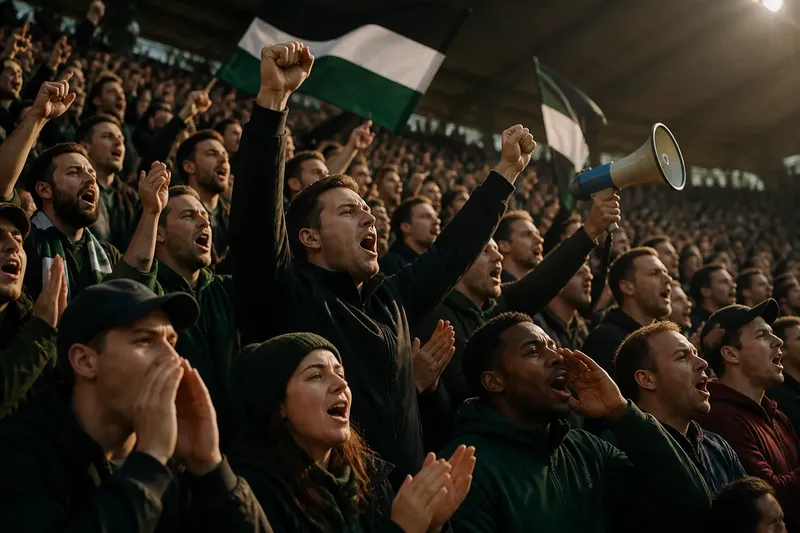
A raised scarf can turn from one supporter’s impulse into a cue that others recognise. Why fans turn a gesture into a ritual depends less on the movement itself than on its timing, its setting and the responses it draws. A fist held aloft, a tap on a rail or a touch to a club badge has no fixed meaning on its own. Repetition gives it a place in a group’s shared vocabulary.
What turns a gesture into a ritual?
A gesture becomes ritual-like when people repeat it in a recognisable setting and treat that repetition as meaningful. It need not be elaborate. A supporter might touch the club badge before taking a seat, knock on a rail when the team emerges, or raise both hands at a familiar moment. The action is small; its significance comes from being expected, noticed or answered.
People make gestures constantly, but not every repeated movement becomes a ritual. Someone may fold a programme the same way each week without anyone else knowing or caring. That can remain a personal habit, while a ritual has a shared frame: other people recognise the cue, the setting gives it context, or participation marks a connection.
There is no official threshold. A gesture can matter to a handful of regulars without becoming a ground-wide custom, and a widely recognised action may carry different meanings for different people. Ritual is not a badge awarded by a crowd; it is a social use that takes shape through repetition.
Why does timing make the gesture legible?
Timing helps people understand what an action is doing. A scarf raised while players walk out may signal welcome or anticipation; the same scarf lifted while someone asks for directions is simply being adjusted. Place and moment turn movement into a cue others can read.
Sport offers recurring occasions for recognition: arrival, a pause in play, a team’s entrance, a difficult stretch or the final whistle. Fans can attach a gesture to one of these moments without explaining it aloud. The moment provides a shared reference point, like a comma in a conversation: it tells people when an action belongs.
Timing also makes variation visible. If a group usually raises a hand after a particular event, a supporter who does so earlier may be anticipating what is coming, while one who waits may be responding to a different signal. Those differences do not necessarily weaken the ritual. They show that participants are reading the occasion, not following a mechanical script.
Ask not only what a gesture means, but when it happens and what has just happened around it.
How can you tell if recognition is spreading?
Look beyond the first circle of participants. A response from a neighbour shows that the gesture has been noticed locally, but it does not by itself show that people further away understand or recognise it. To assess how far recognition reaches, observe the same cue on separate occasions and note where responses appear: beside the person who starts it, elsewhere in the section, or beyond it.
Focus on observable actions rather than guessing at private meaning. Do people turn towards the cue, repeat it at the familiar moment, or make room for someone else to join? Do newcomers respond without being prompted, or do they watch and ask what is happening? A person who does not join may still recognise the ritual, so participation alone is not a complete measure.
Imagine a supporter taps a barrier when the team returns to the pitch after a break. On the first occasion, two neighbours tap along. At the next return, the supporter watches for responses without calling out; a few people farther along the row tap too, while others look over but do not join. On a later occasion, a newcomer in that part of the stand taps at the same moment without a prompt. The observable result is that the cue is recognised beyond its original neighbours, though it remains a local practice rather than a ground-wide custom. If responses stay beside the original supporter, the evidence points to a smaller shared ritual, not wider recognition.
To observe this without turning the crowd into a test, keep the focus on the setting and the action. Do not pressure anyone to join or treat a quiet response as proof of indifference. The practical question is whether the cue is becoming legible to more people, not whether everyone performs it.
Who can join, adapt or decline?
A ritual is shared through participation, but participation should not be mistaken for compulsory agreement. Some fans join because the action feels familiar; others prefer to watch, take part only on certain occasions or express the same feeling another way. A gesture can be meaningful without becoming a test of loyalty.
Access matters. A movement that depends on standing, reaching or holding an object may not suit everyone in the crowd. People can adapt it, respond with a smaller motion or remain present without performing it. That flexibility can preserve the invitation while acknowledging that bodies, space and circumstances differ.
There can also be disagreement about who began a gesture or what it expresses. One group may treat it as a sign of welcome; another may connect it with a particular memory or mood. These readings can coexist, especially when a simple action carries more than one association.
Tradition does not require a single approved version. A ritual can change as people repeat it, and a newer supporter can make a familiar movement their own. What matters is whether participants recognise the connection, not whether every hand moves at precisely the same angle.
What can a gesture mean besides belonging?
Belonging is one possible meaning, but not the only one. A repeated gesture may express anticipation, affection, nervousness, remembrance, humour or solidarity. It can help a group mark a transition, acknowledge an absence or share a feeling that is difficult to put into words during a noisy match.
Meaning may shift with the occasion. A raised scarf can be a welcome in one setting and a tribute in another. A brief touch to a badge might be private reassurance for one person and a visible sign of allegiance to someone watching. The movement alone cannot settle the interpretation; participants and circumstances do that work.
This is why it helps to resist turning a local custom into a universal claim. The same gesture may be absent from another club’s culture, used differently across sections or known only to a small group. Asking someone familiar with the custom, when the moment allows, is usually more informative than assuming its meaning.
Which questions help explain fan gestures?
Does a gesture have to be old to count as a ritual?
No. A newer action can become ritual-like if people repeat it in a shared setting and recognise what it signals. Age may deepen a custom’s associations, but repetition and social recognition do the essential work.
Does everyone in the crowd need to take part?
No. A gesture can be meaningful within a small group, and people may recognise it without joining. The extent of participation varies by place, occasion and individual choice.
Can a gesture mean different things to different supporters?
Yes. Fans may connect the same movement with different memories or feelings while still recognising when and how it is used. Shared practice does not require identical private interpretations.
How can a newcomer respond to an unfamiliar ritual?
They can watch for when it happens, notice whether people nearby respond and ask a fellow supporter about it at a suitable moment. Joining is a choice; understanding the cue does not depend on performing it.
Why can a familiar ritual change or fade?
Rituals depend on people and settings, so they can alter when either changes. A section may move, familiar supporters may be absent, or a gesture may no longer fit the moment it once marked. New participants can preserve the basic cue while changing its style, or attach it to a different occasion.
A custom can fade without a dramatic break. If fewer people recognise the timing, the action becomes harder to read; if it no longer feels relevant, fewer people choose to repeat it. That does not erase what it meant to those who took part. It shows that shared meaning needs attention rather than automatic inheritance.
Fans who want a ritual to continue can make its context visible without policing it. A brief explanation to a newcomer, a clear gesture at its familiar moment or room for different forms of participation can help the practice remain understandable. The invitation, not perfect uniformity, lets a small movement keep its meaning.
Why fans turn a gesture into a ritual comes down to an exchange: someone acts, others recognise the moment, and participation gives the cue a shared life. When a scarf rises or a hand taps a rail, notice how far the response travels—and whether people can recognise the cue without being asked to perform it.